
Ready-made games with no personal questions
For quiet simultaneous answers, choose Year Off for year guesses or Google Showdown for search-interest comparisons. Both can start with one guest; allow about 10 minutes for a short game, plus joining and instructions.
With at least three guests, choose Odd Signal for emoji clues and deduction, Meme Match for picture reactions and voting, or Watch Your Words for spoken clues and hidden traps. Their catalogue estimates are about 20, 15 and 20 minutes respectively; settings and discussion change the length.
The Scale starts with two guests and scores individual guesses. Explain It needs at least four guests across two teams. Preview words, phrases and images for your group, and check your event plan allowance.
The ten activities below also include exercises you can run yourself with paper or meeting chat.
Choose the result before you choose the game
A useful team activity does one clear job and ends before people start wishing they were somewhere else. For most small teams, that means a 5–10 minute opener inside a meeting, a 15–30 minute shared task or a 30–60 minute hosted game.
| What you need | Choose | People | Time |
|---|---|---|---|
| Settle into a regular meeting | One useful question or a visual quiz | 3–10 | 5–10 min |
| Help a new team start talking | Three shared things or The Scale | 4–12 | 10–25 min |
| Practise making a decision | Put it in order or Closest estimate | 4–16 | 15–30 min |
| Run a relaxed team social | Year Off, Meme Match, Odd Signal or a hosted quiz | 4–20 | 30–60 min |
| Add something that runs in the background | Light secret missions | 6–20 | Throughout |
Three small-group plans with a clear finish
4–6 people: one shared ranking, 15 minutes
Use paper or a shared document. Give everyone two minutes to rank five useful items for a fictional camping trip, eight minutes to agree one group list and five minutes to explain one change of mind. There is no official winner: the aim is to hear how people reach a decision.
7–10 people: pairs and a visual quiz, 15 minutes
Prepare five image questions with checked answers and a shared screen. Mix people into pairs or trios. Allow two minutes for instructions, five minutes for answers and eight minutes for reveals and discussion. Give one point per correct answer; use a small shared prize or simply announce the score.
11–15 people: three groups and a practical problem, 25 minutes
Write a short fictional brief, such as planning an accessible team lunch with a fixed budget. Give groups five minutes to read it, ten to agree a proposal and two minutes each to share it. Use the last four minutes to compare trade-offs. Supply the same constraints to every group and rotate the spokesperson.
For remote groups, put the brief and timer in the call chat before using breakout rooms. Give each group one shared document and a return time. In a hybrid meeting, include remote colleagues in the discussion explicitly; room noise must not become an advantage.
Five rules that stop it feeling like forced fun
Keep it inside paid working time
Schedule the activity within working hours, or make an after-hours social optional.
Say why you are doing it and when it ends
Open with a concrete brief: “We have 15 minutes to meet the new team before the planning session.”
Offer a pass
Let people skip a prompt or choose a role such as scorekeeper or timekeeper.
Use a task instead of telling people to mingle
Pairs and trios need a prompt, puzzle or decision. Without one, established colleagues stay together and newcomers have to invent a reason to join them.
Offer more than one useful role
Not everyone wants to perform, move around or speak first. Clue-giver, answerer, scorekeeper and timekeeper can all contribute without doing the same thing.
10 team-building activities
Times include instructions and discussion; preparation time is listed separately.
For a text-based quiz on paper, use our 20 team trivia questions with a host answer key. Choose ten for a shorter round or use the full four-round set for a team social.
One useful question
- Group
- 3–10 people
- Total time
- 5–10 minutes
- Pace
- Low energy
- Best for
- A regular meeting
Ask one question about a team habit and give each person about 30 seconds to answer.
How to run it
- Choose one of the prompts below and display it for everyone to read.
- Give everyone one quiet minute to think, then allow about 30 seconds per answer.
- Name one pattern you noticed, then move to the meeting agenda.
- What would confuse a new starter about how we work?
- Which small team habit saves you time?
- What information do you wish arrived a little earlier?
The Scale
- Group
- 4–16 people
- Total time
- 15–25 minutes
- Pace
- Medium energy
- Best for
- A new or mixed team
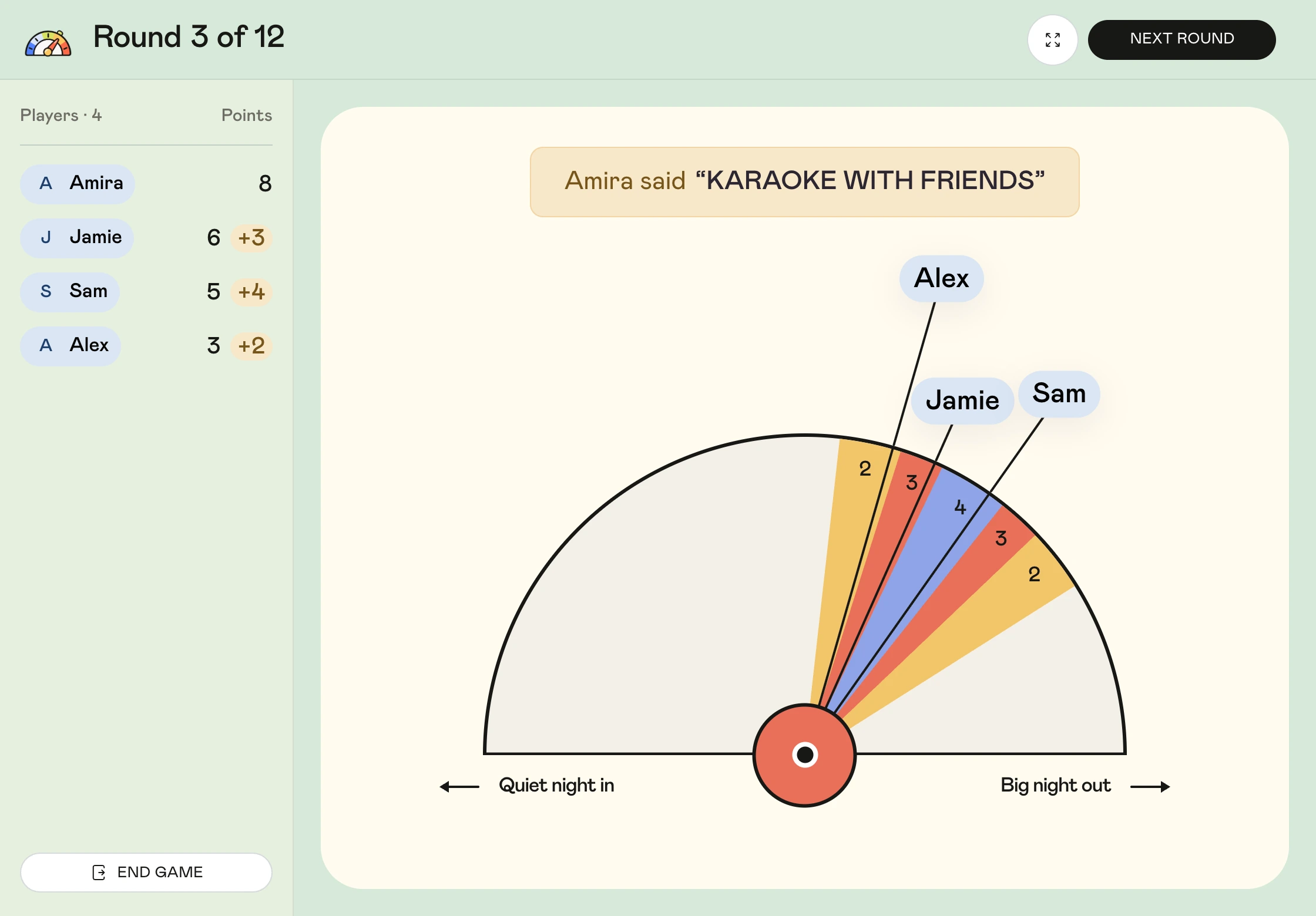
Guests prepare clues for private targets between two opposites. Everyone else sees each clue and places an individual guess. Discussion is welcome; each player keeps their own score.
How to run it
- Open The Scale, choose packs and the number of scales per guest, and let guests join from their phone browsers.
- Guests see their targets privately and write clues before the guessing rounds. Keep the number of scales small for a short session.
- Show one prepared clue and its two endpoints. Everyone except its author can discuss it, then each submits an individual guess.
- Reveal the target and guesses, leave a moment for reactions and move to the next clue. Allow time for clue preparation as well as guessing.
Five-question visual quiz
- Group
- 4–20 people
- Total time
- 10–15 minutes
- Pace
- Medium energy
- Best for
- A meeting warm-up
A compact picture round gives people something concrete to discuss. It also gives a new starter a reason to speak to one or two colleagues without addressing the whole room.
How to run it
- Choose five questions that can be understood from the shared screen. Avoid specialist knowledge that only one department is likely to have.
- Put people into pairs or trios. Mix established colleagues with newer team members instead of asking everyone to choose a partner.
- Give teams about 45 seconds per question and collect one answer from each team.
- Reveal the answers and announce the winner.
Put it in order
- Group
- 4–16 people
- Total time
- 15–20 minutes
- Pace
- Low to medium
- Best for
- Decision-making practice
Give each group five things to rank: events, prices, project steps or industry milestones. The value is in the reasoning, not in remembering the correct order.
How to run it
- Prepare five items and one defensible correct order. Print them, put them on a slide or send them in the meeting chat.
- Create mixed groups of two to four people and give them seven minutes to agree one order.
- Ask each group to share one decision that caused disagreement. Do not make every group present its full list.
- Reveal the answer and ask one closing question: what helped you reach a decision?
Explain the word
- Group
- 4–20 people
- Total time
- 20–30 minutes
- Pace
- High energy
- Best for
- A team social
A player describes a word without using the obvious clues while teammates guess. Short turns keep the pace up and stop one confident person from owning the room.
How to run it
- Split the group into two mixed teams and let everyone join from a phone browser.
- Explain the forbidden-clue rule before the timer starts. Give the first clue-giver a practice word if the group is new to the format.
- Run 45–60 second turns. Rotate clue-givers and let anyone pass without explaining why.
- Finish after every willing player has had a turn, or at the advertised end time—whichever comes first.
Offer a scorekeeper or team-captain role to anyone who does not want to give clues.
Three shared things
- Group
- 4–12 people
- Total time
- 10–15 minutes
- Pace
- Low energy
- Best for
- Helping people mix
In mixed pairs or trios, find three specific things everyone shares. A small task is easier than an instruction to network, especially when people do not know each other well.
How to run it
- Create the pairs or trios yourself so existing friendship groups do not simply stay together.
- Suggest food, films, hobbies or travel as starting topics.
- Allow six minutes to find three connections.
- Ask each group for one connection to share with the room.
Team timeline
- Group
- 4–16 people
- Total time
- 20–30 minutes
- Pace
- Medium energy
- Best for
- Onboarding or a project reset
Teams arrange company, project or industry milestones in order. A good timeline helps people understand how the work fits together without sitting through another presentation.
How to run it
- Prepare eight to ten milestones. Include enough context for a newcomer to reason about them; avoid a list of unexplained dates.
- Give each mixed group the same cards and 10 minutes to arrange them.
- Reveal the timeline one item at a time and add only the context people need to understand why it mattered.
- Finish by asking which connection or dependency was new to them.
Preparation takes about 10–15 minutes if the milestones already exist. It takes longer if you need to research or fact-check company history.
A photo with a story
- Group
- 4–10 people
- Total time
- 15–25 minutes
- Pace
- Low energy
- Best for
- A team that already has some trust
Each person brings a photograph of an object, place or meal and tells the story behind it.
How to run it
- Send the photo prompt before the meeting.
- Provide a fallback set of public images so anyone can choose one on the day instead of using a personal photo.
- Give each participant up to one minute to explain their choice.
- Allow one follow-up question per photo before moving to the next person.
Light secret missions
- Group
- 6–20 people
- Total time
- 30–90 minutes
- Pace
- Flexible
- Best for
- A longer team social
Each person receives a small private challenge, such as finding two colleagues who recommend the same film. Everyone should know that missions are running even though individual tasks stay secret.
How to run it
- Tell the group when missions start and when you will reveal them.
- Send each player one mission on their phone, such as finding two colleagues who recommend the same film.
- Let missions run alongside food, conversation or another game rather than demanding everyone’s constant attention.
- At the end, invite players to reveal their completed missions.
Closest estimate
- Group
- 4–20 people
- Total time
- 15–20 minutes
- Pace
- Medium energy
- Best for
- A mixed-knowledge group
Ask numerical questions that nobody is expected to know exactly. Teams discuss assumptions, submit one estimate and score a point for the closest answer.
How to run it
- Prepare five numerical questions connected to everyday life, the industry or a neutral shared interest.
- Create teams of two to four. Ask them to submit one number and write down one assumption behind it.
- Reveal the answer after every question and ask the closest team to explain its reasoning in one sentence.
- Keep a simple score and finish after five questions. The nearest estimate wins; exact knowledge is not required.
- How many cups of coffee are sold in the UK each day?
- How many minutes does the average commuter spend travelling in a year?
- How many support requests did our team resolve last quarter?
If you use company data, choose figures everyone is allowed to see and explain the source when you reveal the answer.
For a longer session, combine activities instead of stretching one
A practical 30-minute session
- 5 minExplain the purpose and run one useful question
- 20 minPlay The Scale or Put it in order; for a social slot, try Odd Signal
- 5 minClose the exercise or leave time for reactions
A relaxed 60-minute team social
- 5 minWelcome people and explain the choices
- 25 minJoin and play Explain It, Watch Your Words or Odd Signal
- 25 minChoose Meme Match, Year Off or a ready-made quiz; allow time to switch
- 5 minAnnounce the result and let conversation continue
Allow time between games for joining, instructions and a break. Reduce the number of rounds if the first game runs long.
Finish with one question
After a ranking task or team problem, ask: “What helped us make that decision?” Give each group one minute to share a useful observation.
For a social game, announce the scores and invite players to share their favourite moment.